Introduction
The Commission for Youth Apostolate is a dedicated body within the Catholic Church in Kenya that seeks to address the Spiritual, Pastoral, and Social needs of young people. Rooted in the Church’s mission of evangelization, it aims to empower the youth to actively participate in the life of the Church while addressing the unique challenges they face in modern society.
Recognizing the vibrancy and potential of the youth, the Commission provides a platform for holistic growth, enabling young people to encounter Christ, deepen their Faith, and become agents of positive transformation in the Church and society.
Background
The Commission for Youth Apostolate was officially established by the resolution of the Plenary Assembly of the Kenya Conference of Catholic Bishops (KCCB) in November 2024. The assembly’s meeting was held at the Clergy Home, Nairobi. This marked a significant milestone in the Youth Apostolate in Kenya.
KCCB, as the coordinating body of the Catholic Church in Kenya, recognized and appreciated the urgent need for a unified and structured approach to Youth Apostolate. The Commission is a direct response to the Bishops’ collective vision of empowering young people to become active contributors to the Church’s mission and society’s transformation.
In establishing this Commission, the Bishops acknowledged the critical role that young people play in the Church and the underlying key challenges they face, such as:
- The impact of rapidly changing cultural, technological, and societal shifts that often challenge traditional values and beliefs.
- Increasing rates of unemployment and economic instability affect young people’s sense of purpose and prospects.
- The prevalence of mental health issues, including anxiety and depression, can hinder young people’s spiritual and emotional well-being.
- A lack of solid, faith-based guidance in navigating the complexities of modern life, including relationships, career choices, and personal identity.
- A growing sense of disconnection and disillusionment with the Church, especially among those who struggle to relate their faith to their everyday lives and societal pressures.
- Political issues such as political instability, corruption, and the marginalization of young people in decision-making processes, which can lead to a sense of disenfranchisement and lack of agency in shaping their futures. Young people often face challenges related to voter apathy, lack of political education, and a growing distrust of political systems.
In order to address the challenges, the commission will be focusing on guiding, accompanying young people in their Spiritual, Emotional, and Social development as envisioned in the KCCB’s Vision and Mission to be witnesses to society. It involves various dimensions aimed at fostering holistic growth and deepening the faith of young people.
This will be accomplished through the following;
- Faith Formation
- Leadership Development
- Integration of Modern Tools of Evangelization
- Vocational Discernment
- Accompaniment and counselling
- Life skills formatiom
Management
This task will be accomplished in the following ways:
- Administration
- Communication
- Consultation
- VISION AND MISSION STATEMENT
Vision Statement
A Vision Statement is an aspirational statement that focuses on the future and what the Commission wants to ultimately achieve in the long run.
The Vision Statement of the Commission is:
“ A Christ-centered generation of young people who are spiritually grounded, morally upright, socially responsible, and committed to transforming society according to the Gospel and Catholic Social Teachings.“
Mission Statement
A mission statement is a concise explanation of the Commission’s reason for existence. It describes the Commission’s goal, purpose, and overall intention. The mission statement supports the vision and serves to communicate purpose and direction to young people.
The Commission’s Mission is to:
“To accompany young people in their Faith and life journey by fostering holistic growth, deepening their relationship with Christ, and empowering them to act as agents of evangelization and social change.“
3. | GUIDELINES FOR THE COMMISSION FOR YOUTH APOSTOLATE |
Article 1 – Name Clause
The Commission is referred to as the Commission for Youth Apostolate. It is dedicated to the evangelization, empowerment, and holistic development of young people in the light of the Gospel and the social teachings of the Church. The Commission seeks to nurture the Faith, talents, and leadership potential of the youth while addressing the challenges they face in contemporary society.
The Commission has the task of promoting the dignity and rights of young people, fostering their moral and spiritual formation, and advocating for their active participation in the life of the Church and society. It focuses on key areas such as faith formation, education, mentorship, employment opportunities, mental health, social justice, environmental responsibility, and leadership development.
Rooted in the Church’s mission, the Commission encourages young people to become witnesses of Christ in their daily lives, inspiring them to contribute positively to their communities and to work for justice, peace, and the common good. It provides a platform for young people to express their concerns, aspirations, and creativity, ensuring that they are heard and supported in their journey of faith and personal growth.
- How do we achieve /assist people to reach their goals
- What is going on in the lives of the young people that requires our intervention?
- How do the institutions address their mandate in reference to the social teachings of the Church?
- What strengths/ opportunities do young people have in meeting their daily needs/ bettering their lives?
- What constraints do we foresee in the youth programs, and how shall we overcome them?
Article 2 – Goals and Objectives Clause
The Commission for Youth Apostolate aims to foster the spiritual, moral, intellectual, and social development of young people, equipping them to live as faithful Disciples of Christ and responsible members of society.
The specific objectives of the Commission are:
- Faith Formation – This aims at deepening the faith of young people through catechesis, evangelization, sacraments, retreats, and active participation in the liturgical and sacramental life of the Church.
- Youth Empowerment – It aims at equipping young people with knowledge, skills, and opportunities that enable them to realize their full potential in personal, academic, and professional life.
- Moral and Ethical Growth – It aims at instilling Christian values, ethical leadership, and moral integrity in young people, helping them navigate contemporary challenges with wisdom and faith.
- Pastoral Care and Mentorship – It aims at providing pastoral guidance, mentorship, and accompaniment that foster personal and vocational discernment among the youth.
- Social Justice and Advocacy – It aims at promoting youth involvement in addressing issues of justice, peace, human dignity, and environmental stewardship in line with Catholic social teachings.
- Community life – It aims at strengthening the sense of belonging among young people in the Church by fostering unity, collaboration, and meaningful relationships.
- Digital Evangelization – It aims at utilizing modern media and digital platforms for evangelization, fostering a Christ-centered online presence that engages and educates young people.
- Service and Missionary Spirit – It aims at encouraging young people to engage in acts of charity, volunteerism, and missionary activities that reflect the love of Christ in the world.
The Commission seeks to create a vibrant and inclusive environment where young people can grow in Faith, contribute to the mission of the Church, and respond to the call of God in their lives.
Goals
1. Faith Formation
- Ground Youth in Catholic teaching through catechesis and scripture study.
- Enhance understanding of the Church’s social teachings and their application in daily life.
- Promote active participation in the sacraments and devotionals.
- Leadership and Evangelization : Train youth in servant leadership modeled on Christ.
Equip them to evangelize peers and engage in digital and physical missionary activities.
3. Social Justice and Advocacy
- Mobilize the young people to respond to poverty, inequality, and injustice, guided by CST principles.
- Create platforms for youth to advocate for policies aligned with Gospel values.
4. Ecological Stewardship
Encourage youth participation in environmental conservation, inspired by ‘Laudato Si’.
Expected Outcomes
- Spiritually mature young people rooted in scripture, CST, and Church teachings.
- Empowered leaders who actively evangelize and advocate for justice in society.
- A vibrant, mission-driven youth community contributing to the Church’s mission
Operational Framework for the Youth Apostolate
To effectively implement the objectives of the Commission for Youth Apostolate, a conceptual framework is essential. This framework provides a structured approach to coordinating youth programs and projects while upholding human dignity, justice, and empowerment. It also raises critical questions that guide the Commission’s work:
- What are the real needs and challenges facing young people today?
- Who within the Church and society should take responsibility for addressing these needs?
- What strategies and interventions should be used to empower young people?
- What outcomes should be expected from youth programs and initiatives?
- What injustices affect young people within the Church and society?
- How should these injustices be addressed, and who should be responsible?
- How does the Government of Kenya support youth development, and how can the Church collaborate with it?
- How does the Commission advocate for young people to ensure that institutions mandated to serve them fulfill their responsibilities?
These questions are fundamental in shaping effective youth ministry programs that align with Catholic social teachings and the mission of KCCB. Structures and systems must be in place to ensure that youth programs are implemented fairly, efficiently, and with a clear focus on justice and empowerment.
The Commission recognizes that youth ministry is dynamic, requiring continuous research, development, and evaluation. By collaborating with government agencies, donors, and other stakeholders, the Commission ensures that interventions are impactful, sustainable, and transformative. The ultimate goal is to equip young people with the skills, knowledge, and faith foundation needed to become responsible leaders and active participants in the Church and society.
Final Goal
KCCB, Commission for Youth Apostolate, through collaboration with institutions, government agencies, and partners, the Commission ensures that interventions are impactful, sustainable, and transformative. The ultimate goal is to equip young people with Faith, knowledge, and leadership skills to help them become responsible citizens and witnesses of Christ in the world.
Conceptual Framework of the Commission for Youth Apostolate
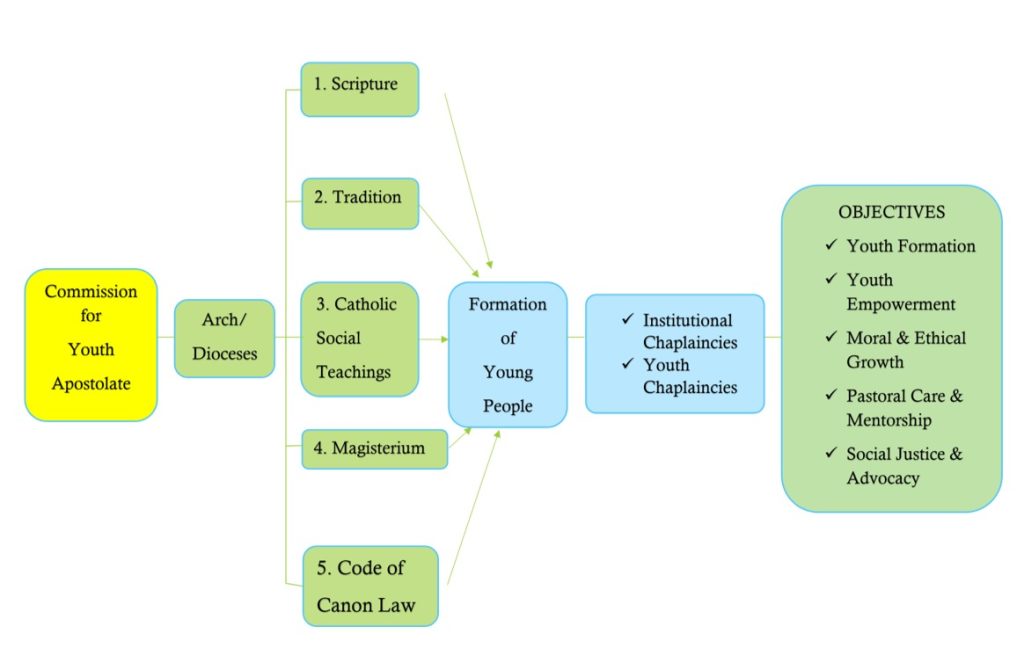
The Conceptual Framework of the Commission for Youth Apostolate integrates Catholic Social Teaching, Scripture, the Magisterium, the Code of Canon Law, and Tradition to ground its mission in the core teachings of the Church.
The framework is built on five key sources of Catholic Faith:
- Scripture
The Word of God serves as the foundation for all youth apostolate activities:
- Isaiah 40:31: “But those who hope in the Lord will renew their strength.” This inspires the mission to empower young people to persevere in faith and life.
- 1 Timothy 4:12: “Let no one despise your youth, but set the believers an example in speech, conduct, love, faith, and purity.”
- Matthew 25:40: “Whatever you did for one of the least of these brothers and sisters of mine, you did for me.” This calls young people to social justice and service.
- Catholic Social Teaching (CST)
The pastoral approach reflects the principles of CST, such as:
- Human Dignity: Recognizing every young person as created in the image of God.
- Solidarity: Encouraging unity among young people and with the larger community.
- Option for the Poor and Vulnerable: Advocating for the marginalized youth and empowering them to overcome structural injustices.
- Care for Creation: Involving youth in environmental stewardship and sustainability.
- Magisterium
The teachings of the Church guide the commission’s vision, with particular reference to:
Gaudium et Spes: The Pastoral Constitution on the Church in the Modern World calls for engaging with the challenges young people face in light of the Gospel.
“Gravissimum Educationis” (Declaration on Christian Education) – 1965
This document from the Second Vatican Council emphasizes the importance of education for youth and highlights the Church’s role in ensuring that education is aligned with Christian values.
“Populorum Progressio” (On the Development of Peoples) – 1967, Pope Paul VI
While not exclusively focused on youth, this encyclical addresses the issues of development, poverty, and social justice, which are crucial concerns for young people today.
“Fides et Ratio” (Faith and Reason) – 1998, Pope John Paul II
Focuses on the relationship between faith and reason and encourages young people, especially students, to engage with both faith and intellectual pursuits in their lives.
“Christus Vivit” (Christ is Alive) – 2019, Pope Francis
An apostolic exhortation specifically dedicated to the youth, affirming their importance in the life of the Church. Pope Francis calls on young people to live out their faith actively and to engage with social, cultural, and political issues.
“Evangelii Gaudium” (The Joy of the Gospel) – 2013, Pope Francis
While focused on evangelization, this encyclical stresses the role of young people in the new evangelization and the need to invite them to be active participants in the life of the Church.
“Redemptoris Missio” (Mission of the Redeemer) – 1990, Pope John Paul II
Addresses the mission of the Church in the modern world and invites young people to actively participate in missionary work and spread the Gospel.
“Caritas in Veritate” (Charity in Truth) – 2009, Pope Benedict XVI
This encyclical addresses social issues, justice, and the common good, providing a framework for young people, especially students, to live out their faith through social action.
“Laborem Exercens” (On Human Work) – 1981, Pope John Paul II
While focused on the dignity of work, this encyclical also speaks to the importance of providing young people with meaningful employment opportunities and encouraging them to contribute to society with their talents.
“Lumen Fidei” (The Light of Faith) – 2013, Pope Francis
This encyclical invites young people to allow the light of faith to guide their lives, helping them to grow in their understanding of the world through the lens of faith.
“Centesimus Annus” (The Hundredth Year) – 1991, Pope John Paul II
Addresses the social and political challenges of the modern world, including the importance of solidarity and social justice, which are significant concerns for youth, especially students in politically unstable environments.
- Tradition
The Apostolate draws from:
- Liturgical Practices: Celebrations and sacraments that foster faith, including youth-focused liturgies and Eucharistic adoration.
- Spiritual Devotions: Encouraging practices like the Rosary, devotion to Mary, and the Saints as role models for young people.
- Historical Youth Movements: Inspiration from St. John Bosco’s work with young people, emphasizing holistic growth in education and faith.
- Code of Canon Law
It serves as a fundamental source of Catholic Faith, providing legal and pastoral guidelines that shape the Church’s mission, including its outreach to youth.
Here are two pertinent canons:
- Canon 217: “Since they are called by baptism to lead a life in keeping with the teaching of the gospel, the Christian faithful have the right to a Christian education by which they are to be instructed properly to strive for the maturity of the human person and at the same time to know and live the mystery of salvation.”
This canon emphasizes the Church’s responsibility to provide all baptized individuals, especially the youth, with a comprehensive Christian education that fosters personal development and a deep understanding of their faith.
- Canon 793 §1: “Parents and those who take their place are bound by the obligation and possess the right of educating their offspring. Catholic parents also have the duty and right of choosing those means and institutions through which they can provide more suitably for the Catholic education of their children, according to local circumstances.”
This canon underscores the vital role of parents in the Education of their children, highlighting their duty and right to select appropriate means and institutions that align with Catholic values, thereby ensuring a robust Faith foundation for the youth.
Core Values
The framework integrates Catholic Social Teaching and spiritual values:
- Faith: Nurturing a Christ-centered life through prayer, scripture, and sacraments.
- Justice: Promoting equity, inclusion, and social transformation based on Gospel values.
- Community: Building strong networks of collaboration and mutual support.
- Integrity: Guiding young people toward moral and ethical decision-making.
- Service: Encouraging selfless acts of charity and love.
Article 3: Corporate Structure
1. Governance Structure
- i) The Commission for Youth Apostolate operates under the General Secretariat and carries out its programs and activities to bear witness to Christ through its commitment to the holistic development of young people. This includes providing opportunities for spiritual growth, social responsibility, leadership development, and empowerment, all in accordance with the Catholic Church’s Social Teachings.
- ii) The Commission is headed by a Bishop Chair and a Bishop vice-chair, who provide spiritual and strategic guidance for the work of the Commission.
iii) The National Executive Secretary is responsible for the day-to-day operations of the Commission. This position ensures the smooth implementation of programs, supervises staff, coordinates with Diocesan Youth offices, and ensures that activities align with the overall mission of the Commission. The Executive Secretary also acts as a liaison between the Commission and other stakeholders, such as government agencies, educational institutions, and partner organizations.
- iv) The National Executive Committee of the Commission will be composed of:
- IIIA Bishop Chair
- A Bishop Vice Chair
- General Secretary
- National Executive Secretary
- Ecclesiastical Province Representative-Chaplains
- Institutional chaplaincies
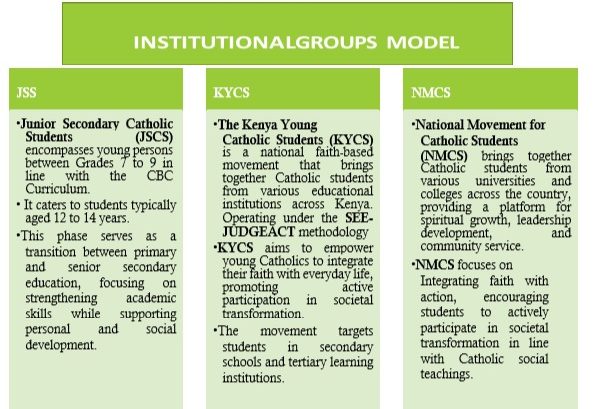
- 4 National Moderators drawn from the four different groups, i.e., National Youth Council, K-YCS, K-NMCS, and YCA
- 4 experts (Lawyer, Resource mobilizer, and
Educationist)
Mandate of the National Executive Committee
- Provide inter-Diocesan Commission-specific policy harmonization
- To serve as the technical supervisory and oversight body at the national level for attainment of the commission goals in line with the KCCB Strategic Plan.
- To review and approve project proposals, annual work plans, and narrative for reports on progress
- To be responsible for the appraisal of the performance of the National Executive Secretary of the commission.
- To meet at least quarterly, and the minutes of the Meeting are sent to members of the Permanent Council of Bishops.
2. Management Structure
The Leadership of the Commission will be under the National Executive Secretary:
- National Executive Secretary of the Commission
Roles and Responsibilities of the National Executive Secretary for the Commission for Youth Apostolate – KCCB
- Taking Minutes and Documentation – Record and maintain accurate minutes of commission meetings, ensuring proper documentation and follow-up on resolutions.
- Implementation of KCCB Policies – Ensure that all youth Apostolate activities align with the pastoral priorities and directives set by the Kenya Conference of Catholic Bishops (KCCB).
- Coordination of Youth Programs – Oversee the planning, execution, and evaluation of National youth programs, projects, and initiatives within the Catholic Church in Kenya.
- Liaison between KCCB and Diocesan Youth Offices – Serve as the link between the bishops, Diocesan youth chaplains, animators, and other stakeholders to foster unity and effective collaboration.
- Resource Mobilization and Management – Facilitate fundraising efforts, budget planning, and proper utilization of resources to sustain youth Apostolate programs.
- Capacity Building and Formation – Organize training, workshops, and formation sessions for youth leaders, chaplains, and animators to enhance their effectiveness in ministry.
- Advocacy and Representation – Represent the Commission for Youth Apostolate at National and International forums, advocating for youth concerns within the Church and society.
- Monitoring and Evaluation – Regularly assess the impact of youth Apostolate initiatives, providing reports and recommendations to KCCB for continuous improvement.
- Administration
i) Management Accountability Authority
The management of the Commission is under the oversight
The role of the NES that manage the activities of the Commission.
ii) Financial Accountability
The financial policies of KCCB shall be followed as provided. The approval and authorization process will follow as provided in this document. To approve means to confirm or to commend, while to authorize means to empower. In this case, approved refers to the outcome of an internal control process, whereas authorization represents a higher level of responsibility and, as a result, both drive and determine the outcomes of an approval process. Therefore, the following shall apply in relation to
Accountability mandate
- The National Executive Secretary of the commission shall authorize and approve all transactions.
Article 4: Activity Clause
1. Structure
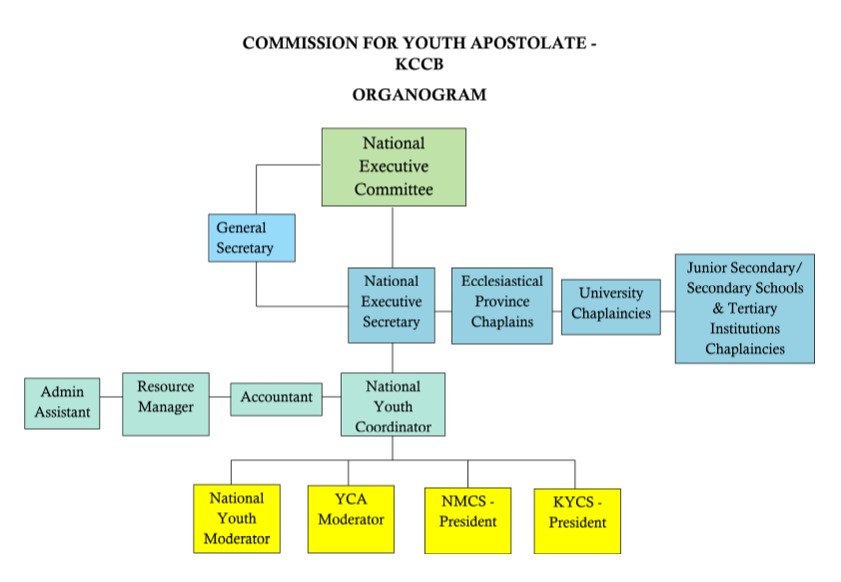
There shall be an organizational structure that indicates the Commission’s chain of command (hierarchy) for the various positions and to show how they interact with each other for the optimum operation of the Commission.
Organizational design and reporting structures
The organogram deals with the chain of command on who reports to whom, so as to bring about harmony and effective and efficient communication in the implementation of tasks inherent to the Commission for Youth Apostolate as per the policies of KCCB.
The General Secretary coordinates, facilitates, and administers operations within the Secretariat, assisted by the Deputy General Secretary.
The National Executive Secretary heads the Commission.
- Communication Channels within the commission to
Arch/Dioceses
Communication Channels within the Youth Commission
Effective communication is essential for the Commission for Youth Apostolate to successfully execute its core functions, including planning, organizing, leading, and coordinating youth initiatives.
To ensure clear and efficient information flow, all key communications should cascade from the National Executive Secretary (NES) to the Arch/Diocesan Chaplains, who must then engage their respective Arch/Dioceses to align efforts with the Commission’s vision and objectives.
This will be achieved through:
- Commission-wide meetings – For updates, strategic discussions, and major announcements affecting youth programs.
- Departmental meetings – To ensure proper coordination, planning, and execution of youth-focused initiatives.
- Task-specific meetings – Smaller, focused discussions based on operational needs, project implementation, and emerging youth concerns.
By fostering structured and open communication, the Youth Commission will enhance collaboration, transparency, and efficiency in empowering young people.
- Communication Channels within the Commission:
i) National Executive Secretary (NES)
The National Executive Secretary is the link between the Commission and KCCB Management and other staff. The National Executive Secretary is responsible for the implementation of the Commission’s objectives and the flow of information from Management to the Arch/Dioceses and vice versa. He manages communication from the commission to various stakeholders.
He consults the Bishop Chair / Bishop Vice Chair of the Commission regarding matters of the Commission.
The NES is the spokesperson for the Commission on strategic issues and ensures that the Commission delivers on its mission and vision.
4. Compliance
The Commission shall comply with the risk, legal, and audit matters as per the regulatory and legal policies of KCCB.
- Missionary Youth Movement
Comprises young people mostly in the adolescent stage. The age range is between 13-18 years.
- MYM Role Models:
- St. Kizito
- Youth Serving Christ (YSC) are all young people who are 18 – 26 years of age, or those who have finished high school, are 26 years and below, and not married or with a child.
- YSC Role Models:
- St. Charles Lwanga &
- Young Catholic Adults comprises young people between the ages of 27 – 35 years. The majority have completed their university and tertiary education and are either working or seeking jobs.
- They are under