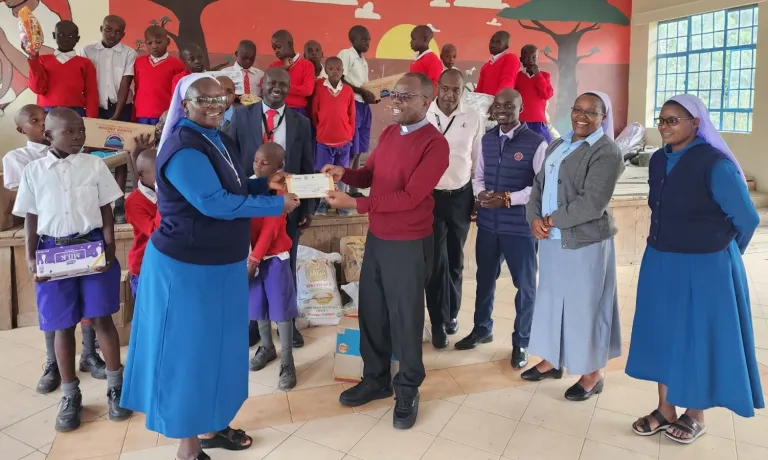
Staff from the Kenya Conference of Catholic Bishops (KCCB) recently visited Kwetu Home of Peace in Kamulu, a rehabilitation center for street boys aged between 8 and 14 years, in a gesture of solidarity and charity inspired by the Lenten season and the Church’s mission of upholding human dignity.
The visit was part of the annual KCCB Lenten charity initiative, where staff members voluntarily fast every Friday during Lent and contribute the money they would ordinarily spend on lunch towards supporting vulnerable members of society. After Easter, the pooled contributions are used to assist a selected charitable institution through donations of foodstuffs, clothing, and financial support.
This year’s outreach was guided by the 2026 KCCB Lenten Campaign theme, “A Just, Peaceful and United Kenya: Upholding Human Dignity.” A representation of KCCB staff from different departments and communities, led by members of the Liturgical Committee, took part in the visit to Kwetu Home of Peace.
The delegation included the National Executive Secretary for KCCB – Commission for Social Communications, Rev. Fr. Gerald Omunyin, Sr. Rose Wambui from the PMS office, Paul Ngetich from Administration, David Mwangi from Missio Invest Office, Brenda Muthoni from the Commission for Education and Religious Education, and Claight Omondi from the Finance Department. The team spent time interacting with the children and caregivers while learning more about the center’s rehabilitation and family reintegration programs.
Managed by the Catholic Church, Kwetu Home of Peace offers shelter, counseling, education, spiritual formation, and life-skills training to children rescued from the streets. During the visit, Sr. Clementina Chelagat, the Assistant Administrator, together with Sr. Florence Wanjiku, explained how the institution helps children recover from trauma, neglect, violence, and the harsh realities of street life.
According to the administrators, the center currently hosts 67 boys under the care of three caregivers, with ten more children expected to join soon. The growing number of children in need continues to increase demand for better facilities and enhanced rehabilitation support.
They explained that the rehabilitation journey begins with a “lock-in” phase, where children are welcomed into a safe and stable environment and provided with food, clothing, shelter, counseling, and basic education as they gradually adapt to a structured lifestyle.
Once stability is restored, the children move into a second phase that focuses on education, discipline, social development, and spiritual growth. They attend school, participate in counseling sessions, catechism classes, prayers, and life-skills training aimed at preparing them for responsible living.

The sisters emphasized the importance of practical life skills such as cooking, cleanliness, and household responsibilities. Workshop activities also help the boys develop communication skills, teamwork, discipline, and self-confidence.
“We nurture them step by step, just like a farmer takes care of a seed until it grows into a healthy plant,” said Chelagat. “Our goal is to help them become responsible young people capable of living meaningful lives.”
Counseling and emotional healing remain central to the rehabilitation process, as many of the children arrive deeply wounded by painful experiences from the streets. Caregivers, therefore, create safe spaces where the boys can freely express themselves and receive guidance, care, and emotional support.
Spiritual formation also plays an important role in the program. The children participate in prayers, Sunday activities, catechism classes, and sacramental preparation in collaboration with the Church and their families.
The center further prioritizes family reintegration. Before children are reunited with their families, caregivers conduct home visits and counseling sessions to prepare both the children and their relatives for reconciliation and reunion.
“We want every child to return home transformed and ready to rebuild relationships,” the caregivers noted. “Many children eventually go back to school, reconnect with their families, and seek forgiveness where necessary.”
Speaking during the visit, Chelagat thanked KCCB staff for their generosity and appealed for continued collaboration in supporting vulnerable children and strengthening rehabilitation programs.
The KCCB delegation commended the dedication of the sisters and caregivers at Kwetu Home of Peace, describing their service as a living witness to the Church’s mission of healing, hope, mercy, and restoration within society.